How AI Is Changing Sales Demos: Claude, Gemini and the Rise of AI-Assisted Selling
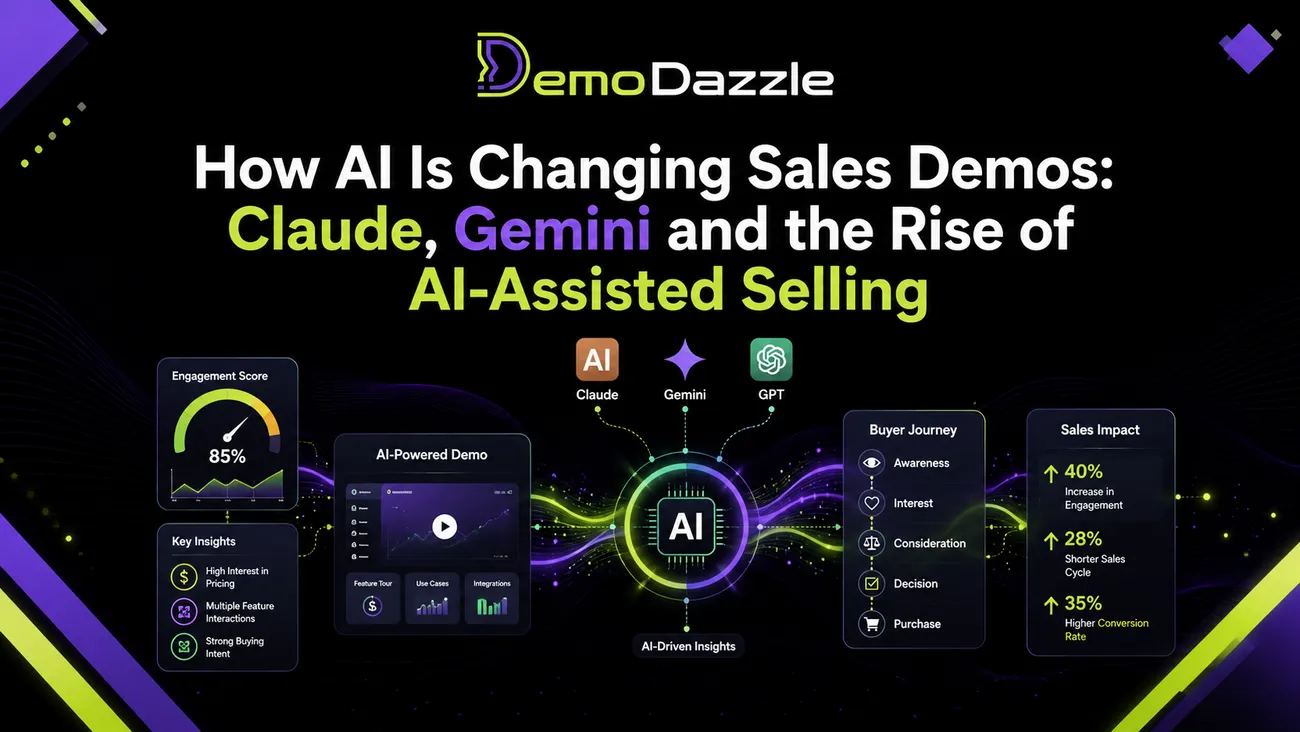
Sales demos are shifting from scheduled, one-size-fits-all presentations to on-demand, personalized, AI-powered experiences. This post explains how Claude AI and Google Gemini help with research, prep, and follow-up, and how specialized tools like DemoDazzle enable interactive and agentic demos that scale personalization without burning out teams.
How AI Is Changing Sales Demos: Claude, Gemini and the Rise of AI-Assisted Selling
Sales demos used to follow a predictable script. A prospect requested a meeting, a sales engineer or account executive blocked time on the calendar, and everyone hoped the live walkthrough would land. That model is rapidly becoming outdated.
Buyers now research vendors extensively before speaking to a human. They arrive informed, skeptical, and short on patience for generic feature tours. At the same time, sales teams face pressure to deliver more personalized experiences at higher volume. The result is a major shift toward AI sales tools and sales automation that transform how demos are prepared, delivered, and followed up.
Two of the most capable general-purpose models driving this change are Claude AI and Google Gemini. Together with specialized platforms like DemoDazzle, they are powering the rise of generative AI sales and AI-assisted selling.
The Old Demo Model Is Breaking
Traditional demos create bottlenecks. Sales engineers spend hours prepping environments, customizing slides, and researching accounts only for a portion of those meetings to involve unqualified or low-intent buyers. Consistency suffers across reps, and scaling personalized demos is nearly impossible without burning out the team.
Modern buyers increasingly expect on-demand access. They use tools like ChatGPT, Claude AI, and Google Gemini to compare vendors, surface objections, and form opinions long before a sales call. The first “sales conversation” often happens with an AI system, not a human rep.
This has created demand for demos that are interactive, always available, personalized, and capable of capturing buying signals automatically. Solutions such as DemoDazzle are helping teams meet that expectation by turning static product walkthroughs into dynamic, AI-assisted experiences.
How Claude AI Is Reshaping Sales Preparation and Enablement
Claude AI (from Anthropic) has become a favorite among sales and revenue teams for deep reasoning, long-context work, and high-quality writing. Its large context window allows teams to feed it product documentation, call transcripts, CRM data, competitive intelligence, and industry research in a single conversation.
Common high-value uses in the sales process include:
- Building detailed account dossiers and deal-prep briefs before demos
- Generating personalized discovery questions, objection handlers, and battle cards
- Analyzing call transcripts to extract MEDDPICC insights, next steps, and coaching opportunities
- Drafting follow-up emails, proposals, and one-pagers that reference specific prospect language
- Role-playing difficult buyer personas so reps can practice objection handling
- Creating and updating sales playbooks and enablement content that stay current
Sales teams report meaningful time savings on administrative and preparation work, freeing humans to focus on relationship-building and complex problem-solving. Claude’s strength in sustained, nuanced reasoning makes it particularly effective for longer sales cycles and enterprise deals where context and consistency matter.
How Google Gemini Supports Sales Workflows
Google Gemini brings different advantages, especially for teams already living in Google Workspace. Its tight integration with Gmail, Google Meet, Calendar, Docs, and Sheets, combined with strong multimodal capabilities, makes it highly practical for day-to-day selling.
Teams use Gemini for:
- Instant meeting summaries and action-item extraction from Google Meet recordings
- Rapid research and personalized call scripts grounded in prospect data and recent company news
- Drafting outreach and follow-ups directly inside Gmail
- Generating training agendas, product-launch enablement materials, and visual concepts for decks
- Real-time support during live interactions through Workspace tools
Gemini’s strength in Workspace-native workflows and multimodal understanding helps sellers move faster between research, preparation, delivery, and follow-up without constant tool-switching. For organizations standardized on Google’s ecosystem, it often becomes the default AI assistant layered into existing sales processes.
The Rise of AI-Assisted Selling and Generative AI Sales
Beyond individual model capabilities, the bigger story is the emergence of AI-assisted selling and generative AI sales systems. These go further than chat interfaces. They include:
- Agentic demos : AI agents that guide prospects through interactive product experiences in real time, ask qualifying questions, surface relevant use cases, and route high-intent buyers to human reps
- Interactive and personalized demo platforms that generate tailored walkthroughs based on buyer persona, industry, or stated pain points
- Automated demo production pipelines that turn product recordings into multiple versions (video, interactive, narrated) far faster than manual methods
- Post-demo intelligence that summarizes engagement, generates recaps, and triggers personalized follow-ups
Sales automation now covers much of the repetitive work that previously consumed seller time: CRM updates, meeting scheduling, research synthesis, content generation, and basic qualification. The human role is shifting toward high-judgment activities navigating politics, handling complex objections, designing solutions, and building trust.
Early adopters of these approaches report faster sales cycles, higher conversion from demo to opportunity, better consistency across the team, and improved capacity for sales engineers who no longer run every introductory walkthrough. Platforms like DemoDazzle are making it easier for teams to implement these modern demo experiences without heavy engineering effort.
What This Means for Sales Teams
The most effective teams in 2026 are not replacing sellers with AI. They are building hybrid systems:
- Use Claude AI and Google Gemini for research, preparation, content generation, analysis, and practice.
- Deploy specialized interactive or agentic demo tools for always-on, personalized product experiences.
- Keep humans in the loop for complex discovery, negotiation, executive conversations, and relationship ownership.
- Feed real call and demo data back into the AI systems so playbooks and guidance improve continuously.
Success requires more than just access to the models. Teams need clean data, clear guardrails (especially around pricing, competitive claims, and sensitive information), and processes that treat AI outputs as drafts requiring human review at least initially.
Looking Ahead
Sales demos are evolving from scheduled, one-size-fits-all presentations into dynamic, data-rich experiences that qualify buyers while educating them. Claude AI and Google Gemini are central to this shift because they handle the reasoning, writing, and integration work that makes personalization scalable. Combined with purpose-built demo and sales automation platforms, they form the foundation of modern AI sales and generative AI sales motions.
Organizations that treat these tools as force multipliers rather than magic replacements will free their best people to do the work only humans can do well: understanding nuanced buyer needs, building genuine trust, and closing complex deals.
The demo is no longer just a stage in the funnel. In many cases, it is becoming the first intelligent agent a buyer meets. The teams that design that experience thoughtfully will win more of the conversations that follow. Tools such as DemoDazzle are already helping sales teams make this transition practical and scalable.
Frequently Asked Questions
1. Can Claude AI or Google Gemini actually run a live sales demo? No. Both Claude AI and Google Gemini excel at research, script writing, call preparation, and post-demo analysis, but they cannot independently deliver a visual product walkthrough with real-time screen sharing and voice. For that, teams use specialized AI demo agents or interactive demo platforms.
2. What’s the difference between using Claude AI and Google Gemini for sales? Claude AI is often preferred for deep reasoning, long-context analysis (call transcripts, competitive intelligence, proposal writing), and high-quality content generation. Google Gemini shines in teams already using Google Workspace, offering strong integration with Gmail, Meet, Calendar, and real-time meeting summaries. Many sales organizations use both depending on the task.
3. How does AI-assisted selling improve traditional sales demos? AI-assisted selling and sales automation reduce time spent on preparation, personalization, and follow-up. AI can generate tailored demo scripts, create interactive product experiences, qualify prospects automatically, and draft personalized follow-ups allowing human sellers to focus on complex conversations and relationship building.
4. Is generative AI sales replacing sales reps? No. Generative AI sales tools handle repetitive and research-heavy tasks, but complex B2B deals still require human judgment, trust-building, negotiation, and strategic problem-solving. The most successful teams use AI to augment sellers rather than replace them.
5. How can a sales team start using AI for demos without major disruption? Begin with high-impact, low-risk use cases: using Claude AI or Google Gemini for pre-call research and demo scripting, adding interactive or AI-narrated demos for early-stage prospects, and automating post-call summaries and CRM updates. Gradually expand into agentic demos and fuller sales automation once the team builds confidence and processes.