Concept Selling vs. Product Selling: What’s the Difference and Why It Matters
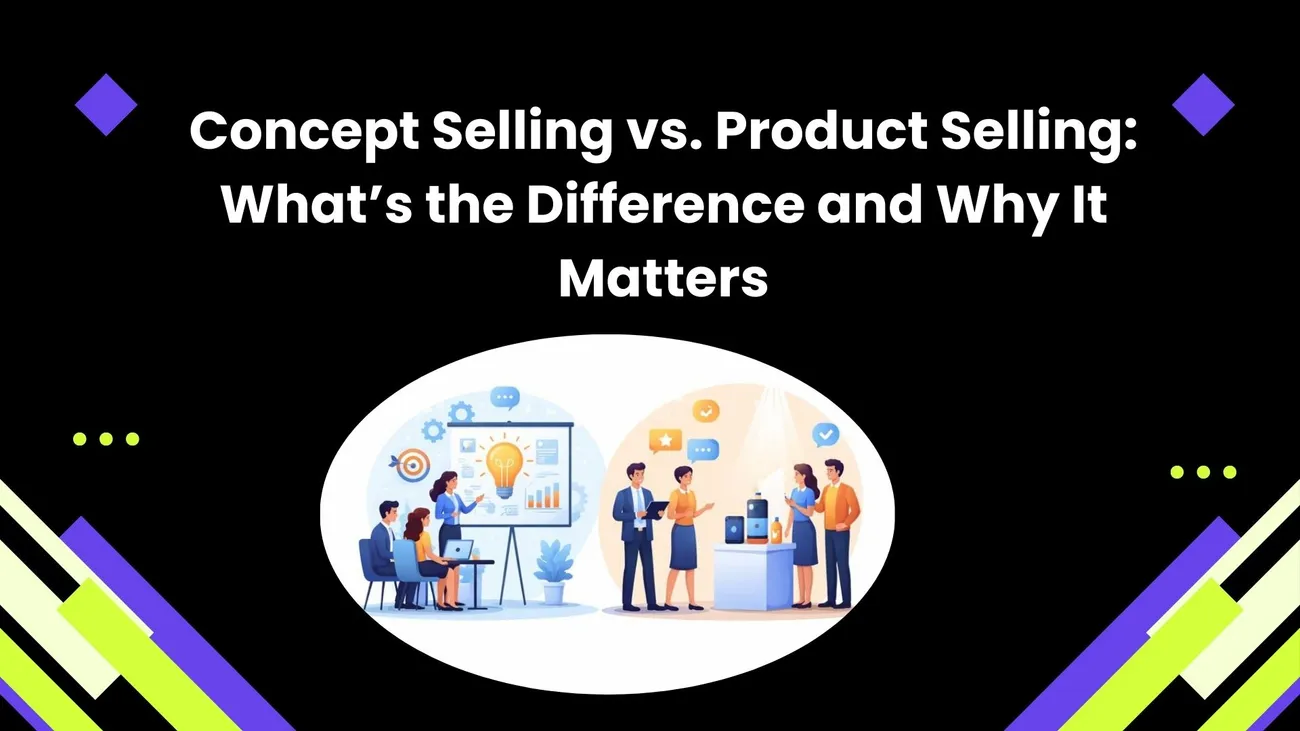
Sales teams talk a lot about approaches: consultative selling, value-based selling, solution selling. But one distinction that still trips teams up is concept selling versus product selling. Which should you use? When do you switch? What does each one actually look like in the real world?
I’ve worked with startups and B2B teams that default to product selling because it feels safer. They talk features, specs, and roadmaps. I’ve also coached teams that started by pitching a higher-level concept and never landed deals because customers couldn’t picture the practical value. Both paths can work, but they demand different skills and different sales motions.
This post explains the difference in plain language, offers practical rules for when to use each approach, and gives a simple playbook for shifting from product selling to concept selling without losing deals. If you’re running a SaaS, leading enterprise sales, or building a go-to-market strategy, this is written for you.
Quick definitions
- Product selling focuses on features, specifications, pricing, and demos. The goal is to convince the buyer that your product meets their requirements.
- Concept selling focuses on a bigger idea or outcome. You sell a concept of change, value, or a new way of working, and position your product as the vehicle to get that outcome.
Think of it this way. Product selling answers the question, "What does your thing do?" Concept selling answers, "How will our world be different if we adopt this idea?"
Why the distinction matters
Different buyers buy for different reasons. A procurement person cares about price and contracts. A technical lead cares about integration, latency, and security. The executive cares about revenue, cost savings, and risk. If your sales approach matches what your buyer cares about, you win more often.
Product selling shines when buyers evaluate based on feature fit. That usually happens in later stages of the buying process, or when the problem is well-defined. Concept selling works best when the buyer has a vague problem or when your solution changes how they work. It helps create demand instead of just competing for it.
In my experience, companies that rely only on product selling leave value on the table. They get stuck in feature wars and heavy discounting. Companies that sell concepts well command higher prices, create stickier relationships, and win strategic deals. That said, concept selling is riskier and requires more effort across the sales process.
How to tell which approach your customer needs
Ask a few simple questions early in the conversation. The answers give you a good hint about whether to lead with a product demo or with a concept discussion.
- Is the customer clear about the problem they need to solve, or are they exploring options?
- Does the buyer have a defined evaluation criteria list, or are they asking high-level questions about outcomes?
- Is this an enterprise strategic initiative, or a department-level tool buy?
If the answers point to exploration and outcome uncertainty, you should start with concept selling. If they have a detailed RFP or a technical checklist, product selling will be necessary.
What product selling looks like
Product selling is straightforward. You demonstrate features, run through use cases, and make sure the product checklist passes. This approach works when buyers know what they want and need to compare vendors quickly.
Here’s a typical product-selling flow:
- Discovery focuses on requirements and constraints.
- Demo highlights how your product meets each requirement.
- Proof points and case studies show relevant wins.
- Commercials, procurement, and closing.
Simple example: A retailer needs a payment gateway that supports specific payment methods and PCI compliance. They have a technical checklist. You match your product features to the checklist. Done.
One trap I see a lot: sales teams assume product selling means you can skip exploring outcomes. Don’t. Even in product sales, a short conversation about why those features matter can unlock upsell and reduce churn later.
What concept selling looks like
Concept selling starts with a conversation about the future. You don’t open with a demo. You open with a point of view, a pattern, or a problem framing that the buyer recognizes. Then you show a path from their current state to the new state you promise.
Typical concept-selling flow:
- Problem framing and alignment on outcomes.
- Shared vision for how things could work differently.
- Proof with pilots, case studies, or models that connect the concept to quantifiable benefits.
- Joint roadmap and executive buy-in, followed by implementation planning.
Short example: Instead of pitching a marketing automation tool by features, you lead with "How to reduce time-to-deal by 30 percent using intent-based nurture and SDR orchestration." That phrase sets up a strategy. The product becomes the mechanism to execute it.
A common mistake I see is treating concept selling as a marketing pitch. If you sell a concept, be prepared to co-create. Buyers will test the idea with you. That means pilots, success metrics, and a clear path to value.
When to use each approach
There’s no one-size-fits-all rule, but here are guidelines that help:
- Use product selling when requirements are explicit, the buyer is in a shortlist, or you’re bidding on comparable solutions.
- Use concept selling when the buyer is exploring, the opportunity could change how they operate, or you’re trying to create new demand.
- Mix both approaches when you need to land an initial product win and then expand into strategic conversations.
For startups, concept selling often helps when you have a novel category or a stronger value proposition than feature parity. For established SaaS companies with many competitors, product selling helps win deals where buyers evaluate on specifics.

How to transition from product selling to concept selling
Switching approaches doesn't happen overnight. Teams need to change conversations, metrics, and sometimes compensation. Here’s a practical path I’ve used with several clients.
- Start with discovery. Train reps to ask "Why now?" and "What would success look like?" These two questions push the conversation toward outcomes.
- Create a simple concept narrative. This is a one-paragraph thesis that explains the change you enable and the outcomes customers achieve.
- Build a pilot offer. Concept selling relies heavily on pilots or proofs of value. Keep pilots small, measurable, and time-boxed.
- Equip marketing with the new story. Case studies, whitepapers, and one-pagers should reflect the concept, not just product features.
- Measure the right metrics. Track pilots converted to paid, value realized in pilots, and stakeholder expansion. Don’t obsess only over won deals.
I've noticed that pilots that try to do too much fail. Keep pilots focused on a single measurable outcome. Pick a small metric you can move in 6 to 8 weeks.
Conversation examples — simple and practical
Below are short scripts your reps can use. These are simple, human, and easy to adapt.
Product selling opener:
"Tell me about the requirements your team has put together. Which systems must integrate, and what are the nonnegotiables on security and uptime?"
Concept selling opener:
"If we could reduce your invoice reconciliation time by half, what would that change for your finance team? What would change for your customers?"
Use the first when you need to qualify against a technical checklist. Use the second when you want someone to imagine a different future. Both are short and put the buyer in control.
Common mistakes and pitfalls
Teams often make the same errors when trying to apply these approaches. Here are a few to watch for.
- Jumping to a demo too soon. A demo without context becomes a feature dump.
- Overcomplicating the concept. If the buyer can't repeat your idea in one sentence, it's too complex.
- Skipping measurable outcomes. Concept selling needs metrics. Otherwise it’s just a nice story.
- Using concept selling without executive buy-in. If the concept requires org change, you need sponsorship.
- Thinking one approach fits every deal. The best teams read the buyer and adjust in real time.
One practical tip: write down the buyer's evaluation criteria during discovery. It reveals if they think in product terms or outcome terms. Use that note to guide your next steps.
How marketing and sales should work together
Switching to a concept-selling approach requires tight alignment between marketing and sales. Marketing must prime the market with the idea. Sales must operationalize it with pilots and executive conversations.
Here’s a simple collaboration checklist:
- Create content that explains the concept in plain English. Use real examples and numbers.
- Build a pilot package that sales can hand to a prospect the same day.
- Train sales on value conversations and objection handling tied to the concept.
- Report back insights from pilots to marketing so content evolves.
In my experience, the best content is one that answers three questions: What is the idea? Why does it matter now? How do we prove it quickly? Keep answers short and concrete.
Measuring success: what metrics matter
When you track the right things, you can tell if your approach is working. Here are metrics to use by approach.
Product selling metrics
- Win rate on RFPs and shortlist deals
- Demo-to-opportunity conversion
- Time to close for like-for-like product deals
- Feature adoption rates
Concept selling metrics
- Pilot-to-paid conversion rate
- Value realized during pilot (dollars saved or incremental revenue)
- Number of stakeholders engaged at executive level
- Net revenue retention and expansion after 6 to 12 months
Don’t ignore product metrics in concept-led deals. Feature adoption predicts whether your strategic sale will actually deliver value over time.
Pricing and packaging tips
Pricing plays a different role in each approach. Product selling often focuses on list price and discounts. Concept selling is more about value capture and commercial models that align incentives.
Simple rules:
- In product selling, keep pricing transparent and comparable. Buyers will benchmark you.
- In concept selling, offer outcome-based pilots or shared-risk contracts when possible. Align pricing with measurable value.
- Use modular packaging. Start small for pilots, then add modules for expansion.
Example: Offer a three-month pilot at a reduced rate with clear success criteria. If the pilot hits success metrics, the renewal goes to a value-based price that reflects the benefits the customer realized.
Team structure and skills you’ll need
Both approaches require different strengths. Here’s what to hire or train for:
- For product selling: strong product knowledge, demo skills, and technical pre-sales capabilities.
- For concept selling: facilitators who can lead workshops, commercial thinkers who can model value, and customer success managers who can run pilots.
- Hybrid sellers who can move between both approaches are rare but valuable. Train reps to read the buyer and switch modes.
One hiring tip: look for people who can explain complex ideas in simple language. That skill matters more in concept selling than fancy slide decks.
Simple playbook to get started
If you want to introduce concept selling into your organization without chaos, try this 6-step sprint. It’s practical and used by small teams to get momentum.
- Pick one concept to own. Keep it narrow and relevant to one buyer persona.
- Create a one-page concept brief. Include a one-line thesis, three benefits, and one pilot plan.
- Build a pilot template that includes objectives, timeline, success metrics, and pricing.
- Train two reps and a CSM to run the pilot and collect proof points.
- Run three pilots in 90 days. Measure outcomes and capture testimonials.
- Refine the messaging and scale to the wider sales team.
This approach keeps risk low and forces you to prove the idea with real customers. It also creates repeatable content for broader use.
Short case example — a simple, human story
Here’s a real-world style example without revealing names. A small SaaS company sold analytics dashboards. They were good at product demos and won several mid-market deals, but growth stalled. They kept competing on features and lost to larger vendors on price.
We helped them pick a concept: reducing reporting time and decision latency by creating one source of truth for revenue analytics. Instead of leading with charts and widgets, they began the conversation about decision speed. They offered a three-week pilot to consolidate three reporting sources and show the time saved. The pilot included a measured KPI: minutes saved per report, multiplied by the number of reports per month.
Results: pilots converted at a higher rate, sellers engaged higher-level buyers, and average deal size increased. The product was the same, but the conversation changed. That shift helped them expand into larger accounts.
Tools and templates you can use
You don’t need expensive tools to get started. Here are a few simple templates and tools that help execute concept selling.
- Pilot brief template: objective, timeline, metrics, roles, pricing.
- One-page concept brief: thesis, buyer impact, proof points.
- Value calculator spreadsheet: simple inputs (users, time saved, price) and an output in dollars.
- Simple workshop agenda: 60 minutes to align stakeholders and pick a pilot metric.
Most CRMs can capture pilot progress and metrics. Use a shared folder with one-pagers and pilot templates so reps can launch quickly.
Common objections and how to handle them
Buyers raise the same few objections when you move from product to concept. Here are practical responses that keep the conversation moving.
- Objection: "We need a feature checklist first." Response: "Totally fair. Can we spend 15 minutes mapping your top three requirements? If they match, we can follow with a short pilot to prove outcomes."
- Objection: "Pilots are expensive or risky." Response: "We keep pilots small and measurable. We only scale if the pilot hits its agreed metric. That cuts risk for you."
- Objection: "We have legacy systems." Response: "Great, let's start with a scoped integration. We focus on one workflow to show value quickly."
- Objection: "How do I measure success?" Response: "We define a single KPI up front. It might be time saved, reduction in error rate, or revenue per customer."'
Those replies are short and practical. They push the buyer from theoretical interest to a specific next step.
When not to use concept selling
Concept selling isn't always the right tool. Here are cases where product selling is a better fit:
- When the buyer has a tight RFP and is comparing feature parity.
- When the purchase is tactical and low impact, like replacing a tool with near-identical alternatives.
- When the sales cycle is very short and the buyer is price sensitive.
If you're bidding in a competitive procurement process, focus on product fit, response accuracy, and fast follow-up. You can still weave in a small outcome-focused story, but don't lead with a transformative concept.
Final thoughts — a practical way to think about it
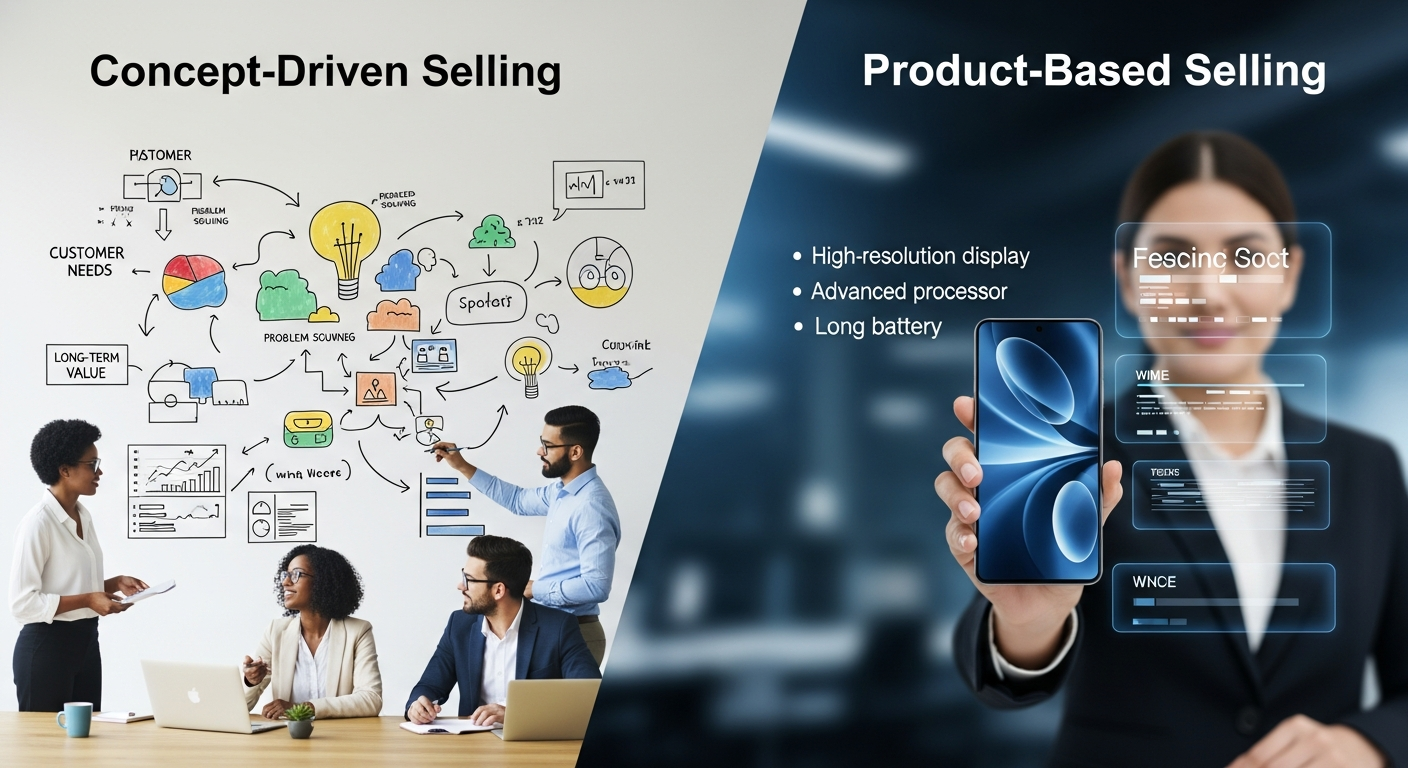
Here’s a simple mental model I use when coaching teams: think of product selling as tactical and concept selling as strategic. Tactical wins are quick and repeatable. Strategic wins take longer but change the customer's behavior and create more value for both sides.
Start by mapping your deals to this grid. Which accounts need a tactical approach? Which are strategic? That mapping helps you allocate your best sellers and tailor your motions.
I’ll end with a small aside. Good selling is simple and human. Whether you’re selling a product or a concept, talk to people, measure outcomes, and be honest about risk. Customers appreciate clarity. They want a partner who helps them avoid mistakes, not more shiny slides.
Helpful Links & Next Steps
If you want to chat about applying these ideas to your sales motion, Book a meeting with us: Book a meeting.
FAQs
1. What is concept selling?
Concept selling focuses on understanding a customer’s problem first and then presenting an idea or solution that addresses their needs, rather than pushing a specific product.
2. How is product selling different from concept selling?
Product selling emphasizes features, specifications, and pricing of a product, while concept selling highlights value, outcomes, and how a solution fits the customer’s goals.
3. Which selling approach works better for B2B businesses?
Concept selling is often more effective in B2B sales because it builds trust, addresses complex needs, and positions the seller as a problem solver rather than just a vendor.
4. Can businesses use both concept selling and product selling together?
Yes. Many successful sales teams use concept selling to identify needs and build value, then apply product selling to present features once the customer is convinced of the solution.